
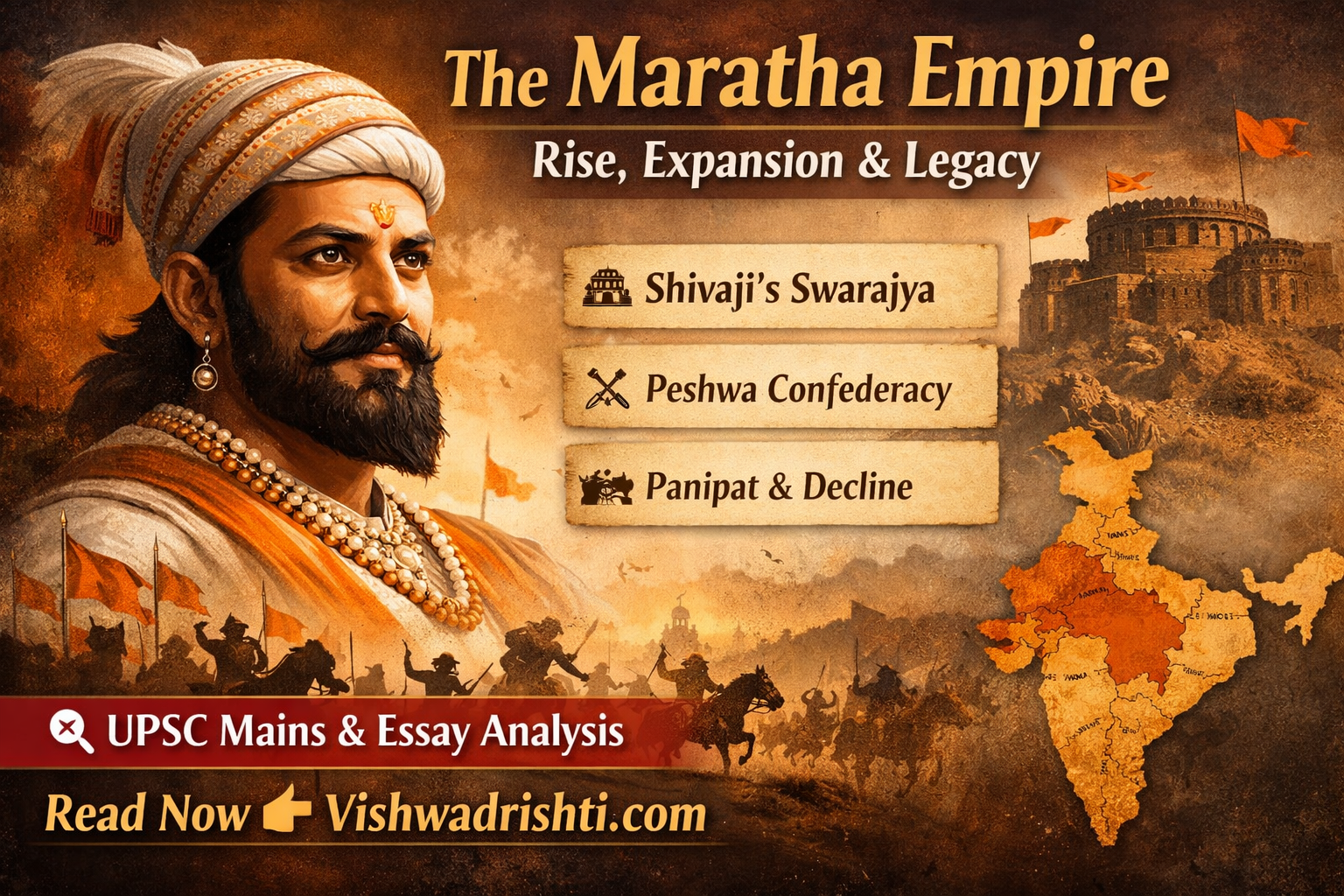
🏹 The Maratha Empire: Rise, Expansion and Legacy
Introduction
The Maratha Empire emerged in the 17th century as the most powerful indigenous political force during the decline of the Mughal Empire. Founded by Chhatrapati Shivaji Maharaj, it transformed from a regional kingdom in the Deccan into a pan-Indian confederacy, shaping India’s political, military, and administrative history.
UPSC Value Line:
The Maratha movement symbolized India’s transition from imperial centralization to indigenous political resurgence.
Historical Background
| Factor | Explanation |
|---|---|
| Mughal Decline | Aurangzeb’s Deccan wars, overextension |
| Deccan Politics | Weakening of Bijapur & Golconda |
| Economic Stress | Jagirdari crisis, heavy taxation |
| Social Context | Rise of regional identities |
| Leadership | Emergence of Shivaji Bhonsle |
Chhatrapati Shivaji Maharaj (1630–1680)
Vision & Ideology
| Aspect | Details |
|---|---|
| Core Idea | Swarajya (Self-rule) |
| Governance | Welfare-oriented kingship |
| Religion | Tolerance & protection of all faiths |
| Ethics | Respect for women & civilians |
Essay Line:
“Shivaji was not merely a conqueror, but a nation-builder.”
Military Innovations
| Feature | Description |
|---|---|
| Ganimi Kava | Guerrilla warfare |
| Fort System | Raigad, Pratapgad, Sinhagad |
| Army | Light cavalry, high mobility |
| Navy | Indigenous naval strength |
| Intelligence | Strong spy network |
Administration – Ashtapradhan Council
| Minister | Portfolio |
|---|---|
| Peshwa | Prime Minister |
| Amatya | Finance |
| Sachiv | Royal correspondence |
| Sumant | Foreign affairs |
| Senapati | Military |
| Nyayadhish | Justice |
| Panditrao | Religious matters |
Expansion of the Maratha Empire
Post-Shivaji Phase
Despite instability under Sambhaji and Rajaram, the Maratha state revived under the Peshwas.
The Peshwa Era (1720–1761)
Baji Rao I (1720–1740)
| Aspect | Details |
|---|---|
| Military Record | Never lost a battle |
| Expansion | Malwa, Gujarat, Bundelkhand |
| Strategy | Rapid cavalry warfare |
Quote:
“Strike at the trunk of the withering tree and the branches will fall.” – Baji Rao I
Maratha Confederacy
| House | Region |
|---|---|
| Scindias | Gwalior |
| Holkars | Indore |
| Gaekwads | Baroda |
| Bhonsles | Nagpur |
UPSC Insight:
Decentralization aided expansion but weakened central authority.
Administration & Economy
Revenue System
| Tax | Meaning |
|---|---|
| Chauth | 25% protection tax |
| Sardeshmukhi | 10% hereditary claim |
- Inspired by Malik Ambar’s system
- Direct state–peasant linkage
Third Battle of Panipat (1761)
Causes
- Overexpansion
- Lack of unity among Maratha chiefs
- Invasion by Ahmad Shah Abdali
Consequences
| Impact | Result |
|---|---|
| Military | Heavy loss of leadership |
| Political | End of Maratha expansion |
| Psychological | Severe setback |
UPSC Line:
Panipat was a strategic defeat, not the end of Maratha power.
Decline of the Maratha Empire
Internal Factors
- Succession disputes
- Weak Peshwa authority
- Confederacy rivalries
External Factors
- Rise of British East India Company
- Anglo-Maratha Wars (1775–1818)
| War | Outcome |
|---|---|
| First | British check |
| Second | British dominance |
| Third | End of Maratha rule (1818) |
Legacy of the Maratha Empire
Political
- Revival of indigenous rule
- End of Mughal supremacy
Military
- Guerrilla warfare tradition
- Inspiration to later resistance movements
Social & Cultural
- Promotion of Marathi language
- Regional identity with national vision
Conclusion
The Maratha Empire was not a mere transitional phase between the Mughals and the British. It represented a distinct Indian political experiment, rooted in local realities yet expansive in ambition.
Mains Value Addition
Quote for Essay/Answers
"“Freedom is a boon which everyone has the right to receive.” — Chhatrapati Shivaji Maharaj"
Key Data & Statistics
At its peak (mid-18th century), the Maratha Empire controlled nearly one-third of the Indian subcontinent. Maratha revenue claims through Chauth (25%) and Sardeshmukhi (10%) extended from the Deccan to North India. The Marathas maintained 300+ forts, making fort-based warfare central to their military strategy.
Committee / Case Law
The Maratha Empire functioned as a political confederacy, not a centralized empire. Power was shared among regional houses like Scindias, Holkars, Gaekwads, and Bhonsles, under the nominal authority of the Peshwa.
UPSC PYQ & Mains Practice
“The establishment of the Maratha Empire was a response to the Mughal policies in the Deccan.” Discuss.
“Evaluate the role of the Marathas in weakening the Mughal Empire.”
Regional powers and their contribution to Indian polity