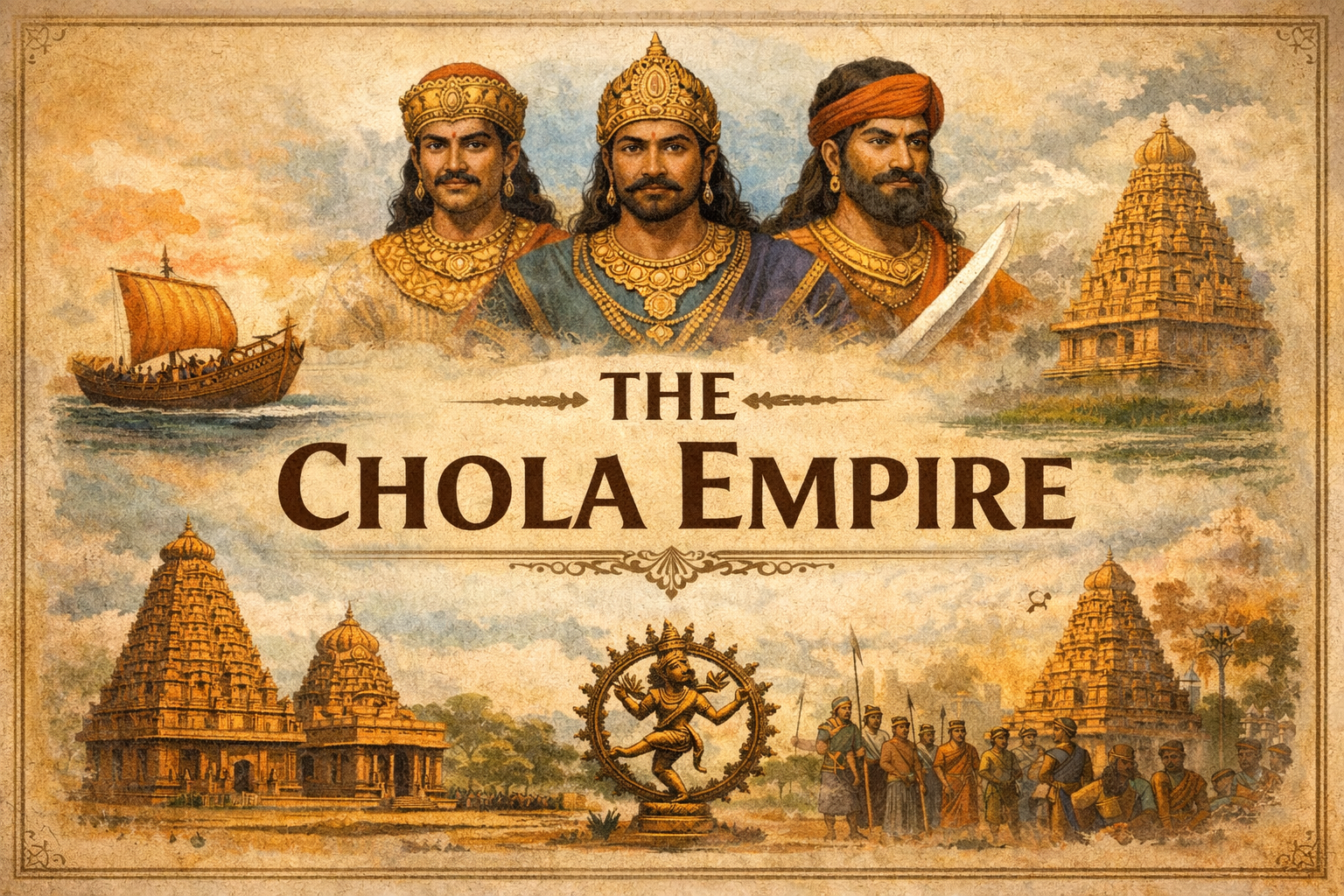
The Chola Empire: Rise, Administration, Culture, Economy, Military and Decline
Introduction
The Chola Empire was one of the longest-ruling dynasties in Indian history, dominating South India and the Indian Ocean region for over 1,500 years. At its peak (9th–13th century CE), the Cholas built a maritime empire, advanced administration, flourishing culture, and strong economy, making them a benchmark of early Indian statecraft.
Timeline Overview
| Period | Key Developments |
|---|---|
| Early Cholas (3rd century BCE–4th century CE) | Mentioned in Ashokan edicts & Sangam literature |
| Medieval Cholas (850–1279 CE) | Imperial expansion under Vijayalaya, Rajaraja I, Rajendra I |
| Decline Phase (13th century CE) | Defeat by Pandyas & Hoysalas |
Rise of the Chola Empire
Key Factors Behind the Rise
- Weakening of Pallavas & Pandyas
- Strategic control over Kaveri delta
- Efficient agrarian surplus
- Strong naval vision
Important Rulers in the Rise
- Vijayalaya Chola (850 CE) – Captured Thanjavur and laid the foundation
- Aditya I – Defeated Pallavas
- Parantaka I – Expanded Chola influence deep into South India
Expansion & Imperial Zenith
Rajaraja Chola I (985–1014 CE)
- Conquered Sri Lanka, Maldives
- Built Brihadeeswarar Temple (Thanjavur)
- Strengthened central administration
- Established strong navy
Rajendra Chola I (1014–1044 CE)
- Conquered Gangetic plains (earned title Gangaikonda Chola)
- Naval expeditions to Srivijaya (Indonesia)
- Established Gangaikonda Cholapuram
- Expanded trade across Southeast Asia
Administrative System (Governance)
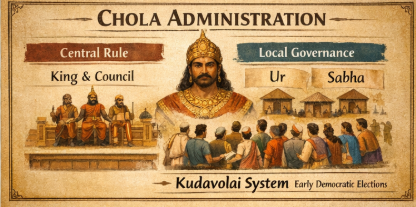
Central Administration
- King was supreme authority
- Assisted by ministers (Amatyas)
- Detailed land and revenue records
Local Self-Government (Key USP)
The Cholas pioneered grassroots democracy.
Village Assemblies
| Assembly | Composition | Function |
|---|---|---|
| Ur | Common villagers | Local administration |
| Sabha | Brahmin villages | Land grants, justice |
| Nagaram | Merchants | Trade regulation |
Kudavolai System
➡️ Election by lot for village committees
➡️ Early form of democratic governance
Economy of the Chola Empire
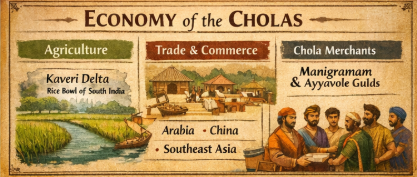
Agriculture
- Backbone of economy
- Advanced irrigation systems (tanks, canals)
- Kaveri delta = “Rice Bowl of South India”
Trade & Commerce
- Internal & Overseas trade
- Trade with:
- China
- Southeast Asia
- Arabia
- Merchant guilds: Manigramam, Ayyavole (500 Lords)
Revenue System
- Land revenue was primary source
- Precise land measurement
- Taxes in cash and kind
Military & Naval Power
Army
- Infantry, cavalry, elephants
- Standing army with local militias
- Well-organized cantonments
Navy (Major Strength)
- First Indian dynasty with strong blue-water navy
- Controlled Indian Ocean trade routes
- Naval expeditions to Southeast Asia
UPSC Value Add:
➡️ Cholas transformed India from a land power into a maritime power
Society & Social Life
Social Structure
- Varna system existed but was flexible
- Prominent role of merchant class
- Women enjoyed relatively better status
Role of Women
- Queens like Sembiyan Mahadevi patronized temples
- Women participated in religious & cultural life
- Property rights existed
Culture & Art
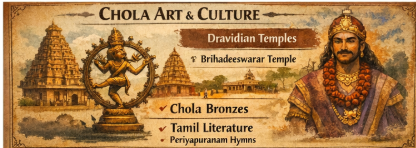
Temple Architecture (Dravidian Style)
- Massive Vimana (tower)
- Gopurams & mandapas
Iconic Temples
- Brihadeeswarar Temple, Thanjavur
- Gangaikonda Cholapuram Temple
- Airavatesvara Temple
(All UNESCO World Heritage Sites)
Sculpture & Bronze Art
- World-famous Chola bronzes
- Nataraja (Cosmic Dancer) icon
- Lost-wax (Cire Perdue) technique
Literature & Language
Tamil Literature
- Royal patronage to Tamil
- Shaiva & Vaishnava Bhakti literature
Important Works
- Periyapuranam – Sekkizhar
- Tevaram & Divya Prabandham hymns
Religion
- Shaivism dominant
- Vaishnavism equally patronized
- Religious tolerance
- Temples as:
- Economic centers
- Educational hubs
- Social institutions
Foreign Relations & Diplomacy
- Diplomatic ties with China (Song dynasty)
- Cultural influence in Southeast Asia
- Spread of Indian culture (Indianization)
Causes of Decline
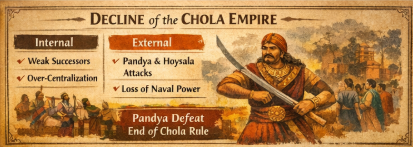
Internal Factors
- Weak successors
- Over-centralization
- Administrative rigidity
External Factors
- Rise of Pandyas
- Attacks by Hoysalas
- Loss of naval dominance
Final Blow
- Defeat by Pandya ruler Jatavarman Sundara Pandyan I
- End of Chola rule by late 13th century
Legacy of the Cholas
- Model of efficient governance
- Maritime vision ahead of its time
- Architectural excellence
- Grassroots democracy
- Cultural unification of South India
Mains Value Addition
Quote for Essay/Answers
"“The Cholas transformed kingship into an institution rooted in administration, maritime vision, and cultural patronage rather than mere conquest.”"
Key Data & Statistics
Cholas maintained one of the earliest blue-water navies in Indian history. Brihadeeswarar Temple (Thanjavur) was built in 1003–1010 CE using granite without modern tools. Chola inscriptions record systematic land surveys and revenue classification. Trade extended to China, Southeast Asia, and Arabia via Indian Ocean routes. Chola bronzes used the lost-wax (Cire Perdue) technique, unmatched in realism.
Committee / Case Law
The Chola state exemplifies decentralized governance with centralized authority. Kudavolai system reflects early democratic principles: Election by lot Eligibility criteria Accountability & disqualification clauses Supports Elinor Ostrom’s theory of effective local institutions (community-managed governance).
UPSC PYQ & Mains Practice
“Discuss the main features of the Chola administration.”
“Assess the significance of the Chola administration in the light of local self-government.”
“Evaluate the contribution of the Cholas to South Indian art and architecture.”
“Indian temples were multifunctional institutions in the medieval period. Discuss with reference to the Chola temples.”