
Introduction
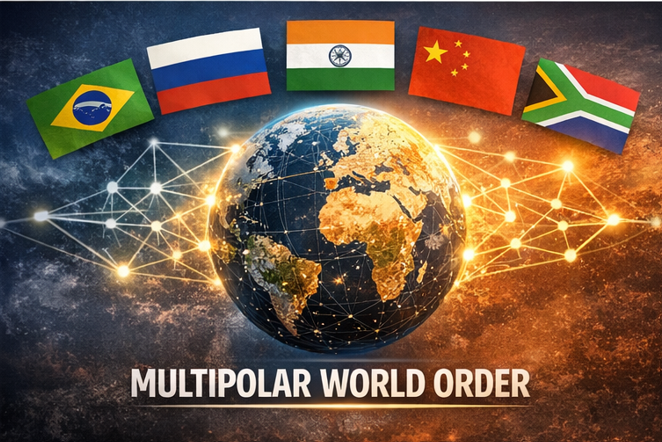
The grouping known as BRICS emerged in the mid-2000s as a response to the dominance of Western-led global financial and political institutions. Initially conceptualised as an economic acronym, BRICS gradually transformed into a formal intergovernmental platform representing major emerging economies.
The original members include Brazil, Russia, India, China, and South Africa.
Objectives of BRICS
BRICS aims to:
- Promote a multipolar world order
- Reform global governance institutions such as the IMF and World Bank
- Strengthen South–South cooperation
- Reduce excessive dependence on Western financial systems
- Enhance cooperation in trade, technology, health, and climate action
Institutional Architecture of BRICS
Key Institutions
| Institution | Purpose |
|---|---|
| New Development Bank (NDB) | Funds infrastructure and sustainable development projects |
| Contingent Reserve Arrangement (CRA) | Financial safety net for balance-of-payment crises |
| BRICS Business Council | Promotes business cooperation |
| BRICS Think Tanks Council | Policy research and academic collaboration |
BRICS Expansion: A Turning Point
Recent expansion has added new members from Asia, Africa, the Middle East, and Latin America, increasing the global footprint of BRICS.
Rationale for Expansion
| Aspect | Explanation |
|---|---|
| Global South Representation | Greater voice for developing countries |
| Energy Security | Inclusion of energy-rich economies |
| Geopolitical Influence | Enhanced global bargaining power |
Concerns
| Concern | Impact |
|---|---|
| Diversity | Harder consensus-building |
| Decision-Making | Slower outcomes |
| Strategic Interests | Conflicting national priorities |
India’s Perspective on BRICS
For India, BRICS:
- Supports strategic autonomy
- Balances Western-dominated institutions
- Enables engagement with China without formal alliances
- Amplifies the voice of developing nations
India often acts as a consensus builder within the grouping.
Key Challenges
| Challenge | Description |
|---|---|
| Economic Asymmetry | Unequal economic power among members |
| Political Differences | Divergent national priorities |
| Weak Institutional Structure | Limited enforcement mechanisms |
| Currency Coordination | Absence of a common currency |
| Geopolitical Tensions | Bilateral conflicts within the group |
BRICS is a coordination forum, not a military or political alliance.
BRICS and the Global Order
BRICS seeks to reform global governance by advocating institutional reform, reducing reliance on the US dollar, and supporting multipolar diplomacy. However, expectations of it replacing existing Western institutions remain overstated.
Way Forward
| Area | Suggested Action |
|---|---|
| Institutions | Strengthen NDB lending capacity |
| Cooperation | Focus on issue-based collaboration |
| Climate Finance | Improve coordination mechanisms |
| Leadership | Leverage India’s Global South diplomacy |
Conclusion
BRICS represents a platform of potential rather than a consolidated power bloc. Its future relevance depends on institutional depth, internal cohesion, and pragmatic leadership, with India playing a stabilising role.