
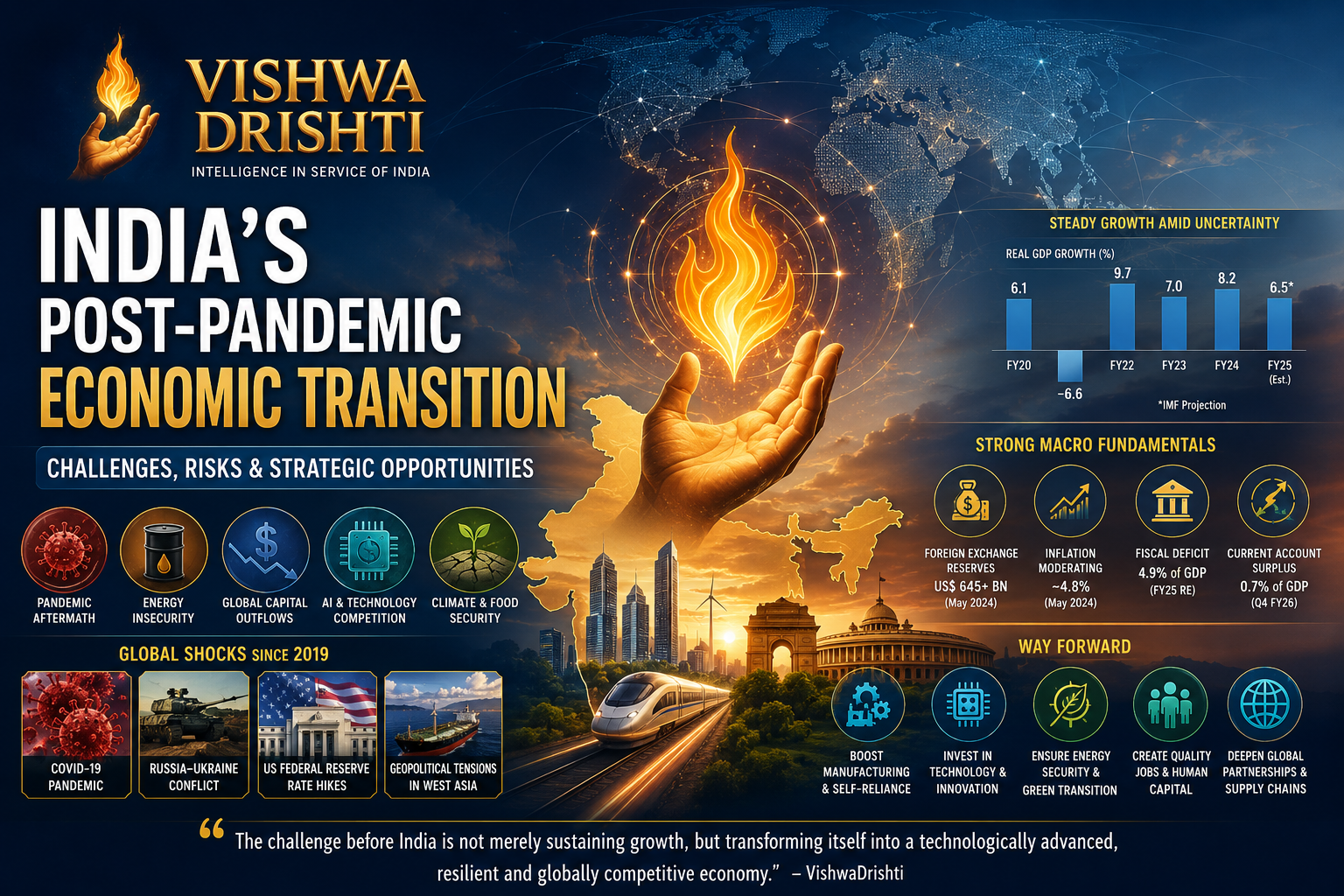
The period since 2019 has been one of the most consequential phases in India's economic journey. The country faced the COVID-19 pandemic, global supply-chain disruptions, the Russia-Ukraine conflict, inflationary pressures, monetary tightening by major central banks, geopolitical tensions in West Asia, and the emergence of Artificial Intelligence (AI) as a transformative force in the global economy.
Despite these disruptions, India remains one of the world's fastest-growing major economies. However, the challenges confronting India have evolved from short-term crisis management to long-term strategic competitiveness involving energy security, technology leadership, employment generation, climate resilience, and external-sector stability.
India's Fiscal Response: From Pandemic Support to Infrastructure-Led Growth
The COVID-19 pandemic necessitated significant public expenditure to support healthcare systems, welfare measures, and economic recovery.
Government Expenditure Trend (% of GDP)
| Financial Year | Revenue Expenditure | Capital Expenditure | Total Public Expenditure |
|---|---|---|---|
| FY20 | 11.7% | 1.7% | 13.4% |
| FY21 | 15.6% | 2.2% | 17.8% |
| FY22 | 12.6% | 2.5% | 15.1% |
| FY23 | 11.8% | 2.7% | 14.5% |
| FY24 | 12.1% | 3.2% | 15.3% |
| FY25 | 11.1% | 3.1% | 14.2% |
| FY26 (RE) | 10.8% | 3.1% | 13.9% |
| FY27 (BE) | 10.5% | 3.1% | 13.6% |
Key Observation
India has gradually reduced pandemic-era revenue expenditure while maintaining elevated levels of capital expenditure. This reflects a strategic shift toward infrastructure-led growth through investments in roads, railways, logistics, ports, digital infrastructure, and manufacturing ecosystems.
External Sector Pressures and Rupee Depreciation
India's external sector has been affected by multiple global shocks since 2020.
USD-INR Exchange Rate Trend
| Year | Average USD/INR |
|---|---|
| 2019 | ₹70.40 |
| 2020 | ₹74.10 |
| 2021 | ₹73.90 |
| 2022 | ₹78.60 |
| 2023 | ₹82.60 |
| 2024 | ₹83.50 |
| 2025 | ₹86.35 |
| 2026 (YTD) | ₹92.91 |
Major Drivers
- COVID-19-induced uncertainty.
- Russia-Ukraine conflict.
- Rising crude oil prices.
- US Federal Reserve interest-rate hikes.
- Higher import bills.
- Capital outflows from emerging markets.
A weaker rupee increases the cost of imports and contributes to inflationary pressures.
Foreign Portfolio Investment (FPI): The Shift in Global Capital Flows
During the pandemic, global liquidity supported strong capital inflows into emerging markets, including India.
FPI Trend
| Year | Net FPI Flow (₹ Crore) |
|---|---|
| 2019 | +1,35,924 |
| 2020 | +1,03,158 |
| 2021 | +50,089 |
| 2022 | -1,21,439 |
| 2023 | +1,71,107 |
| 2024 | +1,65,000 |
| 2025 | -1,66,000 |
| 2026 (YTD) | -2,87,761 |
Reasons for Recent Outflows
- Higher interest rates in developed economies.
- Global risk aversion.
- Geopolitical uncertainty.
- Oil-price volatility.
- Currency depreciation.
- AI-driven global capital reallocation.
While AI-related investments have diverted capital toward semiconductor-focused economies, FPI outflows are also influenced by broader macroeconomic factors.
The AI Revolution and Emerging Technological Competition
The global economy is increasingly being shaped by Artificial Intelligence, advanced computing, and semiconductor technologies.
Market Capitalisation Shift (2026)
| Rank | Country | Approx. Market Capitalisation |
|---|---|---|
| 5 | Taiwan | ~$4.95 Trillion |
| 6 | South Korea | ~$5.00 Trillion |
| 7 | India | ~$4.92 Trillion |
The rise of Taiwan and South Korea has been driven by their dominance in semiconductors through firms such as TSMC, Samsung Electronics, and SK Hynix.
India's strength remains concentrated in IT services rather than AI hardware and semiconductor manufacturing.
Strategic Import Dependence: India's Structural Vulnerability
India's growth remains vulnerable to external shocks due to dependence on critical imports.
Strategic Import Matrix
| Commodity | Import Dependence |
|---|---|
| Crude Oil | 88–91% |
| LNG | 51% |
| Gold | 99% |
| Electronic Components | 65–70% |
| Edible Oils | 55–60% |
| Fertilizer Inputs | 95–100% |
| Coal | 22% |
These imports account for a significant portion of India's annual foreign-exchange outflows.
Energy Security and the Strait of Hormuz
A large share of India's energy imports originates from the Middle East.
Energy Import Exposure
| Commodity | Share from Middle East |
|---|---|
| Crude Oil | 53–55% |
| LNG | 65–66% |
| LPG | More than 90% |
Any disruption in the Strait of Hormuz can result in:
- Higher energy costs.
- Inflationary pressures.
- Current account deterioration.
- Exchange-rate instability.
Energy security therefore remains a critical component of India's economic security.
Climate Risks and Food Inflation
Climate change has emerged as a significant macroeconomic risk.
Potential Impacts of El Niño
- Lower agricultural output.
- Food inflation.
- Water scarcity.
- Rural income stress.
- Increased fiscal burden through relief measures.
Given the large share of food in India's inflation basket, climate-related disruptions can have substantial economic consequences.
The China Factor and Technology Dependence
India continues to rely heavily on imports from China in several strategic sectors.
Major Areas of Dependence
- Electronics.
- Solar modules.
- Battery components.
- Industrial machinery.
- Telecom equipment.
- Manufacturing intermediates.
The challenge extends beyond trade deficits to technological dependence and supply-chain security.
What Still Works in India's Favour?
Despite challenges, India possesses several structural strengths.
India's Strategic Advantages
| Strength | Significance |
|---|---|
| Demographic Dividend | Young workforce and rising consumption |
| Services Exports | Strong forex earnings |
| Remittances | Stable external-sector support |
| Digital Public Infrastructure | UPI, Aadhaar, DigiLocker |
| Infrastructure Investment | Long-term growth multiplier |
| Political Stability | Supports policy continuity |
| Large Domestic Market | Reduces export dependence |
| Manufacturing Expansion | Electronics and defence sectors growing |
| Foreign Exchange Reserves | Buffer against external shocks |
India's Services Advantage
Unlike semiconductor-driven economies, India's strength lies in knowledge-based services.
Key Forex-Earning Sectors
- Information Technology Services.
- Global Capability Centres (GCCs).
- Consulting Services.
- Financial Services.
- Digital Exports.
- Remittances.
These sectors continue to provide resilience against fluctuations in portfolio investment flows.
Government Initiatives
Key Policy Responses
| Challenge | Government Response |
|---|---|
| Fiscal Stress | Fiscal consolidation |
| Manufacturing Gap | Production Linked Incentive (PLI) Scheme |
| Semiconductor Dependence | India Semiconductor Mission |
| Energy Security | Strategic petroleum reserves |
| Climate Risks | Renewable energy expansion |
| Technology Competitiveness | Digital India and AI initiatives |
| Infrastructure Deficit | High capital expenditure strategy |
Way Forward
India must pursue a multi-dimensional strategy:
- Accelerate semiconductor ecosystem development.
- Reduce energy dependence through renewables and green hydrogen.
- Strengthen domestic manufacturing under Make in India.
- Enhance AI and deep-tech research capabilities.
- Improve skilling and employment generation.
- Diversify supply chains and trade partnerships.
- Strengthen climate-resilient agriculture.
- Maintain fiscal prudence while sustaining growth-oriented investments.
Conclusion
India is not facing an immediate macroeconomic crisis. Rather, it is undergoing a strategic transition in an increasingly uncertain global environment.
While challenges such as energy dependence, technology gaps, geopolitical risks, climate change, and capital-flow volatility remain significant, India's demographic advantage, digital infrastructure, services exports, expanding manufacturing base, and infrastructure investments provide strong foundations for future growth.
The central challenge before India is not merely sustaining growth, but transforming itself into a technologically advanced, resilient, and globally competitive economy capable of thriving in the emerging AI-driven world order.
Mains Takeaway
India's post-2019 experience demonstrates that future economic strength will depend not only on GDP growth, but also on energy security, technological self-reliance, climate resilience, employment generation, and strategic competitiveness in a rapidly changing global economy
